
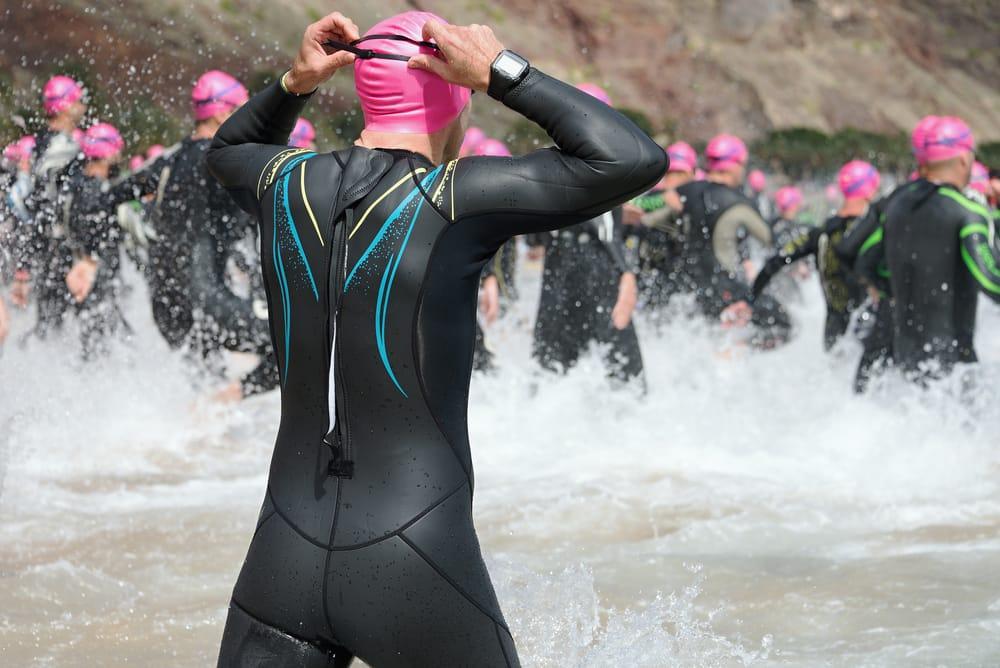
In fact, open water wetsuits are made specifically for swimmers’ needs. With many having additional buoyancy and flexibility built in, this has really helped the growth of open water swimming. If you are open water swimming then do swim in a specific open water swimming wetsuit and don’t make the mistake of swimming in a much heavier surfing wetsuit.
13 May 2026: We have updated this blog for the 2026 season, included recommended wetsuits and information on seasonal rentals. We have previously partnered with Huub and these, along with Zone 3, are the wetsuits we use in our open water coaching sessions. We recommend Huub, Zone 3 and Orca wetsuits.
May 2025: We are concerned at the growing number of brands who are stating they are selling “open water swimming wetsuits”. However, these are not safe open water swimming wetsuits. In Turner Swim’s view, a safe open water wetsuit should be at least a 3:3 thickness for women and a 3:5 thickness for men.
This means 3mm of neoprene around the chest and legs for women, and 3mm of neoprene around the chest for men and 5mm of neoprene around the legs for men. Anything less than these specifications means that swimmers are unlikely to be buoyant on their backs when they lie in an emergency position, nor have sufficient warmth for swimming in the UK at any time other than about 4-6 weeks a year, and be at increased risk of suffering a cardiac arrest. The wetsuits should be full length, with legs and arms covered, to be deemed a safe wetsuit.
Entry level open water swimming wetsuits 2026
The main differences between entry level open water swimming wetsuits and the more expensive open water swimming wetsuits, tend to be the amount of stiffness around the shoulders. The more expensive wetsuits tend to have less stiffness around the shoulders. That said all wetsuits start fairly stiff for the first 5-10 or so swims. The more expensive wetsuits tend to be brighter and more aesthetically pleasing too.
Entry level safe open water swimming wetsuits before the pandemic were priced at around £110 but as we enter 2026, prices range from £199 to £399. The industry has launched thinner material wetsuits which are less buoyant but cheaper, which feels to us a bit like chocolate bars reducing in size to help combat inflation. That said, if you’re naturally buoyant then a cheaper alternative is the Huub OWC wetsuit here.
The 4 safe open water swimming wetsuits we recommend at an entry level are:
1. The Men’s Huub Aegis X wetsuit currently priced at £279.99, and the women’s Huub Aegis X wetsuit.
2. The Women’s surface wetsuit fluo pink priced at £199.00.
Please note we wouldn’t recommend the men’s surface version due to it being a 3:3 wetsuit, which is ideal for women but not men (see below).
3. The Orca Athlex Float V2 men triathlon wetsuit priced at £249.00, with 4.5mm of neoprene (rather than 5mm).
4. Zone-3’s Men’s Vision wetsuit priced at £399.00, and the Zone-3 women’s vision wetsuit priced at £399.
We used to highly recommend the Zone-3 Aspire wetsuit, for men, but this has jumped in price from £225 to £549 in recent years, without a huge change in design.
Advanced level open water swimmer competing in races
Turner Swim coach Andrew has spent the last few years swimming in either an entry level Orca wetsuit, or the Huub Varman, though the Varman currently seems to be out of stock. With both huge amounts of buoyancy and flexibility in the shoulders, this wetsuit is a real pleasure to swim in. With a recommended retail price of £549 there are definitely some fantastic cheaper alternatives to choose if you aren’t going to get obsessed with regular open water swimming.
A 2026 alternative would be the highly acclaimed Huub Agilis II wetsuit, usually priced around £749.
Seasonal open water swimming wetsuit rentals
Seasonal open water swimming wetsuit rentals are now available with Zone 3 for both males and females at £69.00 + a £50 deposit. Click here to view seasonal rentals.
Please note though, these are 3:2 wetsuits, so we would only recommend these when the water is both above 18°C, and for adults who are naturally buoyant. Natural buoyancy levels are determined by your fat to muscle ratio, so the less fat you have then the less buoyant you will be.
Why wear an open water wetsuit?
Keeping warm – Open water swimming does have its risks and sadly each year individuals die competing; this often being attributed to cardiac arrests.
According to Shattock and Tipton (2012), as the body enters cold water there are two autonomic responses; the ‘cold shock response’ and the ‘diving response’. For most individuals, cold shock results in an abnormally rapid heart rate, yet the diving response of holding one’s breath can result in an abnormally slow heart rate. This combination brings the control of the heart into conflict and can lead the heart to produce cardiac arrhythmias (more commonly known as heart rhythm problems), which increases the likelihood of cardiac arrests.
Wearing a wetsuit keeps our body temperature significantly warmer and reduces the cold shock response. We strongly recommend that when you first go into cold water that it is done gradually. We recommend that breath holding does not occur; and that acclimatisation is completed by lying flat on your back before swimming.
Protection – Open water swims take place in lakes, rivers and in the sea. Wetsuits help to protect your body from debris, birds (swans) and other competitors too!
Additional buoyancy – Swimming technology has kept pace with the increasing popularity of open water swimming and triathlons. Most triathlon competitors find their swimming to be the weakest of the three disciplines. More expensive wetsuits have a golf ball effect built into them, designed to trap air and further aid buoyancy, whilst others have foam strips inserted. Buoyancy usually reduces swim times.
British Triathlon rules
In Britain most open water and triathlon events are governed by British Triathlon rules. The water temperature is taken 1 hour before the start of the race and the following rules then apply:
Water Temperature and the Wetsuit Rules:
Less than 14°C then wetsuits must be worn
Between 14°C and 22°C then wetsuits are optional
Above 22°C then wetsuits must not be worn
What are 3:5, 3:8 and 4:4 wetsuits?
3:5 wetsuit
3:5 wetsuits are the most popular and the ones we would recommend for most amateur competitors. 3 and 5 indicate the thickness of a wetsuit at different points, with the 3mm being found on the upper body and 5mm on the lower body. The differential between the thicknesses causes the legs to rise higher in the water, helping to increase efficiency and reduce swim times. These days, although the same lift principles apply, the thickness of the wetsuits can vary far more within the upper body from chest, to lower arm pit and arms.
3:8 wetsuits
3:8 wetsuits are recommended for those who require more lift in their legs while swimming, common for competitors that are particularly muscular. These now seem hard to locate, and a second hand wetsuit may be your best bet for this specification.
4:4 wetsuits
4:4 wetsuits are neutral, providing no differential in thickness and leaving the body to lie in the water in its natural horizontal way. The whole body is likely to be slightly higher in the water than without a wetsuit. Recommended for those who don’t experience faster swim times when they have a pull-buoy between their legs, or those who would like a more natural swim. These also seem to be out of fashion, as thinner wetsuits have been taking over the marketplace.
3:3, 2:3, 2:4 and 1.5:33 wetsuits
These are much more common now, as manufacturers reduce the amount of buoyancy they are providing in wetsuits. If you’re an experienced open water swimmer, swimming a mile in around 24 minutes or less in the open water, or naturally buoyant in water, then these are fine cheaper alternatives.
Which are the main wetsuit brands?
The three main brands we have swum in are Orca, Huub and Zone 3.
How do I avoid chafing and skin irritation?
We recommend putting Body Glide balm around your neck prior to wetsuit use. You might also like to check out Swimmers Itch Guard.
Turner Swim’s top tips for wetsuit longevity:
1. Wear cotton gloves to put on your wetsuit. Wetsuits used to come with gloves and we recommend wearing them to avoid finger nail pinching and tearing your wetsuit. You can buy a pack of cotton gloves fairly easily through Amazon.
2. Pull the wetsuit legs and sleeves far enough up, so that the bottom of the wetsuit is half way up your calf, when putting your wetsuit on. Start with excess material on your body side, to make it easier for your shoulders to go on and zip up. Then you can pull the material back down your legs and arms once it’s on.
3. Rinse immediately after use with clean water and turn inside out to dry. Organised events often have wetsuit showers or a bin of water to rinse them in post-race.
4. You’ve probably heard the phrase, a stitch in time saves nine. Well this is certainly true when it comes to repairing small nicks or cuts in your wetsuit. We recommend drying your wetsuit out and then using Black Witch Glue to repair the neoprene. Remember to place a piece of paper between the two layers of your wetsuit to prevent gluing everything together.
Referencing:
Shattock, M.J. and Tipton, M.J. ‘Autonomic conflict’: a different way to die during cold water immersion? The Journal of Physiology 590 (Pt 14)[Online]. Available at: http://www.ncbi.nlm.nih.gov/pmc/articles/PMC3459038/ [Accessed: 15 May 2016].
Keen to know more?
Join a Turner Swim instructor for open water swim coaching at the Docklands Sailing and Watersports Centre Canary Wharf. We also operate from luxury hotels across London. Visit www.turnerswim.co.uk for further information.